SCBA and EEBD both provide breathable air in hazardous environments, but they serve very different purposes. This guide explains the distinction between entry and escape equipment, common applications, training requirements, and why effective emergency preparedness depends on more than compliant hardware alone.
An alarm sounds. A gas detector has triggered in the process area. Visibility worsens as people make their way toward escape routes and muster stations.
Some reach for Emergency Escape Breathing Devices before evacuating. At the same time, the emergency response team begins preparing Self-Contained Breathing Apparatus before entering the area to assess the situation.
Both pieces of equipment provide breathable air in hazardous environments. They're often stored in the same place, sometimes even side by side. But they exist for different phases of the same emergency, and the distinction matters well beyond terminology. It shapes procurement decisions, training programmes, and maintenance strategies.
Key Takeaways
SCBA supports trained personnel entering hazardous atmospheres to complete operational tasks safely, while EEBDs are solely designed to facilitate rapid evacuation.
Choosing the correct breathing apparatus depends on clearly defined emergency scenarios, ensuring equipment aligns with intended users, risks, and responsibilities.
Effective emergency preparedness relies on training, servicing, inspections, and drills working together, not simply having compliant equipment available.
Why the confusion happens
Both systems protect lives. Both are common across offshore installations, marine vessels, and industrial facilities. To anyone who doesn't work with breathing apparatus daily, they can look interchangeable.
But the distinction isn't based on appearance, it's based on purpose, and specifically on the stage of the emergency each is built for.
An EEBD is designed to help someone escape a hazardous atmosphere safely. An SCBA is designed to enable trained personnel to enter a hazardous atmosphere and carry out a specific task.
That distinction – escape versus entry – drives almost every downstream decision: which equipment to buy, who's trained on what, and how each is inspected and serviced.
SCBA: built for working inside the hazard
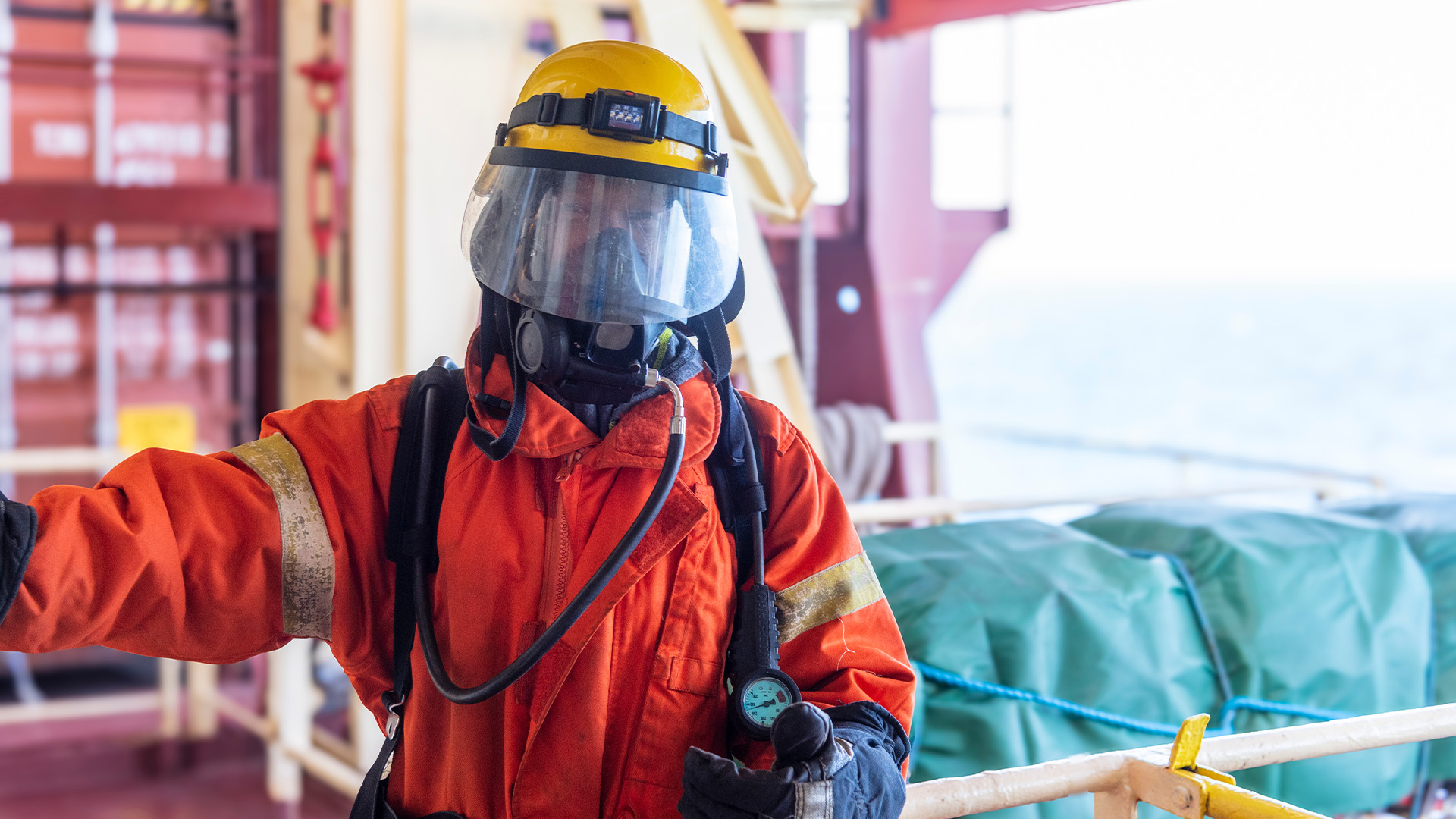
SCBA allows the wearer to work independently of the surrounding atmosphere, carrying a compressed air cylinder on their back. Unlike airline systems, the wearer isn't tethered to an external supply. This gives them additional mobility in dynamic, potentially hazardous environments.
It's typically used where trained personnel need to enter an atmosphere that may be immediately dangerous to life or health: firefighting, confined space entry, rescue operations, incident investigation, industrial maintenance in contaminated atmospheres.
Picture a maintenance team entering a confined space where atmospheric monitoring has flagged the need for respiratory protection. The objective isn't just to survive long enough to get out, it's to complete a planned task safely while staying protected throughout.
But the equipment is only ever half the story. An SCBA cylinder sitting correctly pressurised in a locker tells you nothing about whether the person reaching for it has had a current face-fit test, knows the entry procedure for that specific space, or has practised a failure scenario recently enough to trust their own judgement under pressure. Respiratory protection is a capability, not a purchase. And capability lives in training records and servicing logs as much as in the cylinder itself.
EEBD: built for getting out
EEBDs have one job: get people to safety. They're not intended to support work within a hazardous atmosphere. They provide a short-duration supply of breathable air so people can evacuate when smoke, toxic gases, or oxygen deficiency make normal escape impossible.
Under SOLAS and other regulations, EEBDs must provide a minimum service duration of 10 minutes, and manufacturers commonly build in a margin, many units are rated to 15. That's a legal floor, not a design target, and it tells you something important: EEBDs are engineered around the assumption that escape should already be underway, not that the wearer has time to weigh options.
They're positioned where personnel might need immediate access: accommodation areas, machinery spaces, process plants. They’re designed to be quick and easy to don and simple to operate under stress and poor visibility. They are explicitly not for firefighting, rescue, confined space entry, or remaining in a hazardous atmosphere to work. Their purpose starts the moment someone needs to leave and ends the moment they're safe.
The comparison, side by side
SCBA
EEBD
Why is it worn?
To enter and work within hazardous atmospheres
To escape hazardous atmospheres
Who typically uses it?
Trained emergency responders and specialist personnel
Personnel evacuating the affected area
What happens after donning?
Wearer carries out a defined operational task
Wearer proceeds directly to safety
Specialist training required?
Yes
Familiarisation and emergency drills remain essential
Used for rescue or firefighting?
Yes, where appropriate and by trained personnel
No
Why the equipment is never the whole answer
Here's where most breathing apparatus reviews stop short: they treat this as a specification exercise. Pick the right device, tick the compliance box, move on.
Consider a scenario that plays out more often than it should. A vessel's EEBDs are present, in-date, and correctly logged on the fire control plan. Everything is fully compliant on paper. But the last hands-on escape drill was over a year ago, and when an engine room fire actually triggers an evacuation, a crew member fumbles the donning sequence in the dark, loses seconds they didn't have to spare, and the device performs exactly as specified while the outcome still goes badly. The equipment wasn't the failure. It was the gap between "compliant" and "ready".
That gap is where SCBA and EEBD programmes tend to break down. Not in the kit itself, but in what surrounds it:
Risk assessments that identify where entry equipment is needed versus where escape equipment is needed, and for whom
Competency and refresher training that's actually current, not just scheduled
Face-fit testing, where applicable, kept up to date as people and facial hair change
Inspection and servicing cycles that catch degradation before it becomes a failure in use
Emergency exercises that test equipment, procedures, and people together, not in isolation
Each of these supports the others. Drop one, and the effectiveness of the whole system is compromised, regardless of how good the hardware is.
Three questions worth asking now
Is every item of breathing apparatus matched to a clearly defined emergency scenario? Equipment should exist for a specific, identified purpose, not because it's always been there or because it's the industry norm.
Would every intended user know when and (when not) to use it? Competence includes understanding limitations as well as capability. Someone reaching for an EEBD to attempt a rescue is as much a preparedness failure as someone without one able to escape.
Are inspection, servicing, and competency records actually current? Not scheduled. Current.
Frequently Asked Questions
Breathing apparatus should be selected based on the actions people may need to take during an incident. If personnel are expected only to evacuate, escape equipment may be appropriate. If trained teams must enter a hazardous atmosphere to investigate, rescue, or carry out emergency work, a different level of protection and capability is required. Defining scenarios in advance helps organisations avoid equipment gaps, reduces confusion during emergencies, and ensures training, maintenance, and procedures are aligned with real operational risks rather than assumptions.
Using equipment outside its intended purpose can place both the wearer and others at risk. For example, escape devices are designed to help personnel leave danger, not remain inside it. Attempting a rescue, investigation, or firefighting task with escape equipment could result in insufficient air duration, limited protection, or poor decision-making under pressure. Equally, relying on specialist entry equipment without appropriate training may create a false sense of security. Safe outcomes depend on matching equipment, procedures, and user competence to the task being undertaken.
Training frequency should reflect regulatory requirements, organisational procedures, and the level of risk associated with the work environment. However, competence can decline if practical skills are not used regularly. Refresher sessions, drills, and scenario-based exercises help personnel maintain confidence and muscle memory, particularly for actions that must be completed quickly under stress. Organisations should review training records alongside incident risks rather than relying solely on minimum schedules, ensuring personnel remain genuinely prepared to use equipment effectively when required.
Breathing apparatus may spend long periods in storage before being needed at a critical moment. Regular inspections and servicing help identify issues such as component wear, damaged seals, pressure loss, contamination, or ageing parts before they affect performance. Maintenance also provides assurance that equipment remains ready for use and compliant with manufacturer requirements. A device that appears serviceable externally may still have hidden problems, making structured inspection programmes an essential part of emergency preparedness and operational reliability.
Drills allow organisations to test equipment, procedures, and human performance together in realistic conditions. They reveal practical issues that may not appear in written plans, such as delays in accessing equipment, communication challenges, unfamiliarity with donning procedures, or uncertainty about evacuation routes. Regular exercises help build confidence, reinforce decision-making, and identify improvement opportunities before a real emergency occurs. They also provide evidence that emergency arrangements are functioning as intended rather than existing only as documented procedures.
Certification demonstrates that equipment or processes meet defined requirements, but readiness goes further. It means equipment is available, maintained, and appropriate for the identified risks. It means users understand their responsibilities, have received relevant training, and can perform required actions under pressure. Readiness also requires accurate records, regular exercises, and ongoing review of emergency arrangements. In practical terms, it is the difference between having an emergency response capability documented on paper and being able to execute it effectively when conditions become hazardous.
The real distinction
SCBA enables trained personnel to enter hazardous environments when intervention is required. EEBD enables people to leave those environments when evacuation is the priority. Neither replaces the other, and neither is sufficient on its own.
The organisations best placed to respond when it matters aren't the ones with the most sophisticated equipment, they're the ones where the equipment, the training, and the servicing records all tell the same story: ready, not just certified.
About the Author
Keith Robertson is a trusted leader in offshore, wind farm, and marine safety, with over 40 years in the industry. Known for his expertise in fire and safety systems, Keith has a proven track record of driving growth through direct sales, product innovation, and streamlined safety solutions that reinforce operational efficiency and core business values.
Quality you can trust
Flare takes pride in being rigorously audited and certified by leading industry organisations.
Our certifications include DNV, ABS, Achilles FPAL, and others. We continually strive to meet and exceed safety standards to provide top-quality service to our clients. This commitment to excellence underscores our dedication to maintaining the highest safety and quality standards.