Between 2000 and 2024, at least 1,010 crew and shore workers lost their lives in enclosed spaces aboard ships, an average of forty deaths every year. The number of incidents has not meaningfully declined since InterManager began compiling statistics in 1998. In 2023, fatalities nearly doubled compared to the previous year: 34 deaths from 14 incidents. Most of those who died were not inexperienced. Around two-thirds were Masters, Chief Officers, Chief Engineers, or Second Engineers – the people responsible for assessing the risk.
They had procedures. They had permits. Many had gas detectors. In a significant number of cases, those detectors showed readings that appeared acceptable.
That is the problem IMO Resolution MSC.581(110) was written to address. Adopted on 27 June 2025 and in force since 3 December 2025, it replaces Resolution A.1050(27); the standard that governed enclosed space entry since 2011, through every one of those deaths.
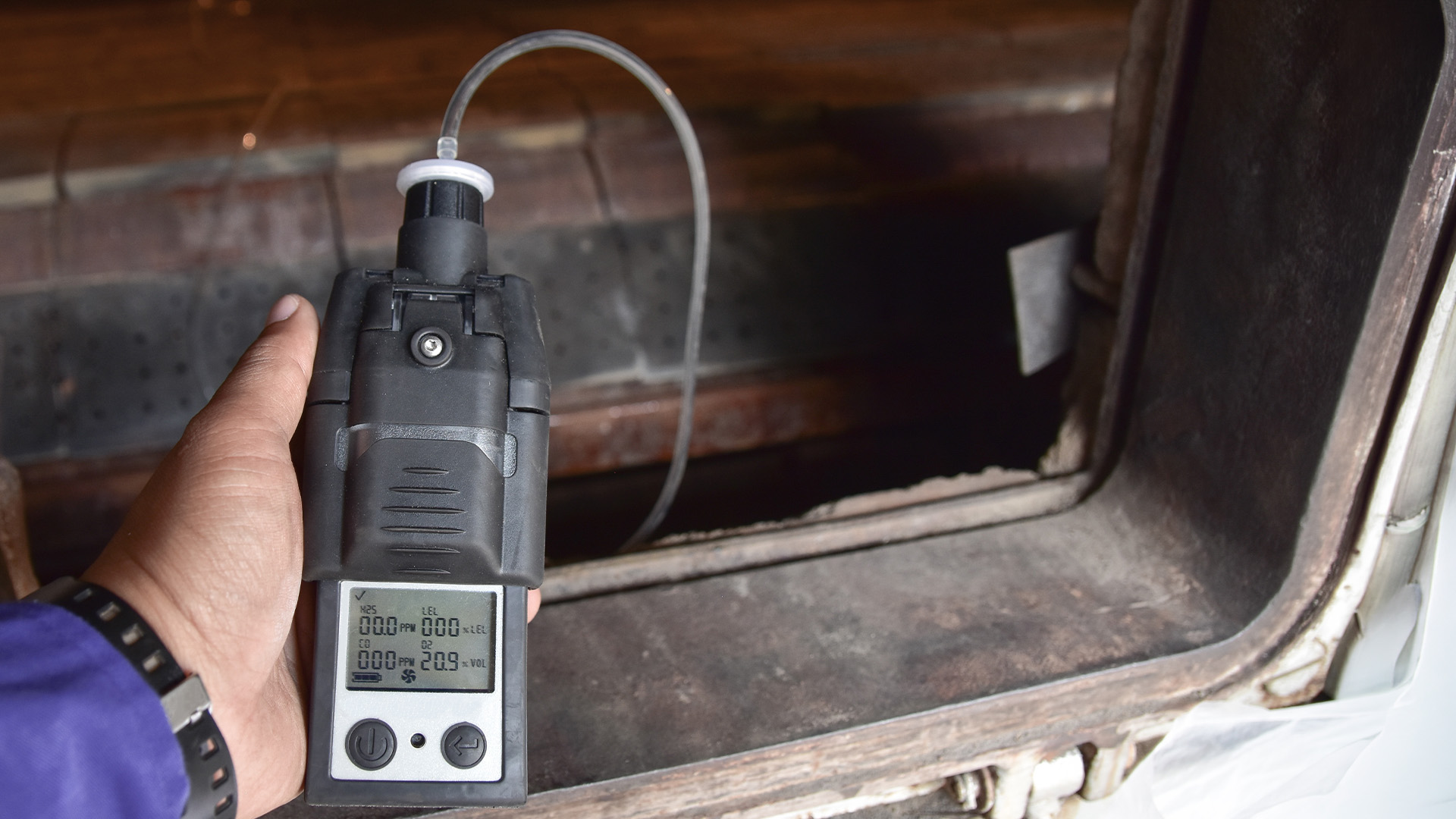
A.1050(27) directed operators toward four-gas detection: oxygen, flammable gases, carbon monoxide, and hydrogen sulphide. For most operations, most of the time, this was treated as sufficient. The problem is that it left a gap that incident investigations kept finding. Carbon dioxide.
CO₂ is colourless, odourless, and produces no irritant warning. At elevated concentrations it causes dizziness, confusion, and impaired judgement. These are all symptoms that can prevent a person from recognising their own incapacitation, let alone acting on it. Critically, it displaces oxygen in a way that does not immediately reduce O₂ readings to alarm levels. A four-gas detector in a space accumulating CO₂ can show a normal oxygen reading right up to the point where conditions become life-threatening.
The cargoes most associated with CO₂ accumulation are not exotic: coal, wood products, wood chips and pellets, metal sulphide concentrates, ferrous materials, seed cake, scrap metal, grain, and timber. These are everyday bulk cargo operations. The hazard was known. The standard simply did not require operators to measure it.
The new resolution closes this directly. CO₂ must now be measured before enclosed space entry, with levels confirmed below 0.5% (5,000 ppm). This is not a recommendation sitting alongside other options, it is an explicit requirement, and RightShip RiSQ 3.2 has already incorporated it into inspection scope. Flag State inspectors and vetting representatives will follow.
For detection equipment, the practical implication is straightforward: a four-gas detector without CO₂ capability does not meet the standard. Operators with existing four-gas units face a choice between supplementing them with dedicated CO₂ monitors or replacing them with instruments that cover all required parameters. Either approach requires reviewing calibration regimes. CO₂ capability is only useful if instruments are correctly bump-tested and calibrated for it, which existing maintenance schedules may not reflect.
MSC.581(110) also mandates continuous monitoring throughout entry operations, not just an initial pre-entry test. Atmospheres in enclosed spaces can change while work is underway. A single reading at the point of entry is not a guarantee of conditions five minutes later.
Equipment is the visible part of the change. The less visible, and arguably more consequential, part is procedural.
The resolution introduces a mandatory vessel-specific Enclosed Space Register covering all spaces, their hazard profiles, ventilation requirements, and how the atmosphere may change depending on cargo or contents. It must be kept current; a register that predates a cargo change is not compliant. Permit-to-Work documentation now carries an eight-hour validity limit, after which full re-assessment and atmospheric re-testing are required. Physical signage marking entry points as safe or unsafe is mandated, with hazardous entries physically locked.
The definition of which spaces require testing has also tightened. Connected spaces (those separated from a known hazardous space only by a manual door) must now be treated as containing a hazardous atmosphere until testing proves otherwise. Many existing procedures do not capture this. A space that was previously considered outside the scope of a permit may now fall within it.
Permit-to-Work documentation, risk assessments, and enclosed space entry plans should all be reviewed against the new requirements before the next relevant operation, not at the next scheduled SMS review.
The statistics carry a detail that procedural and equipment changes alone will not fix: the majority of those who die in enclosed spaces are senior officers. These are not people who are unaware of the rules. They are people who have assessed the situation and concluded – incorrectly – that it was safe to proceed.
CO₂ makes this failure mode worse, not better. Unlike H₂S, which triggers a strong sensory response, or CO, which causes recognisable symptoms at lower concentrations, CO₂ at dangerous levels can produce a gradual cognitive deterioration that a person may not attribute to their environment. By the time judgement is significantly impaired, self-rescue may already be impossible. This is why pre-entry discipline matters more for CO₂ than for gases with clearer warning signs, the in-space feedback loop cannot be relied upon.
Toolbox talks, enclosed space drills, and supervisor briefings need to address this specifically: not just that CO₂ must now be measured, but why the measurement matters in a way that O₂ monitoring alone does not capture, and what the symptom profile actually looks like. Contractor induction materials require the same update. The competent person responsible for authorising entry needs to understand CO₂ behaviour, not just CO₂ thresholds.
MSC.581(110) is in force. The question is not whether to act but how systematically.
Audit current detection equipment against the CO₂ requirement. Confirm whether existing instruments can measure to the 0.5% threshold and whether calibration covers it. Update the Enclosed Space Register to reflect all spaces, connected spaces, and cargo-dependent atmosphere changes. Review Permit-to-Work forms against the eight-hour validity requirement and the physical signage mandate. Check that risk assessments capture displacement gases, not only toxicity and flammability. Revise training materials to address CO₂ specifically.
None of this is technically complex. What it requires is treating the revision as a genuine change in standard rather than a documentation update.
The previous resolution was in place for fourteen years. Across those fourteen years, the death rate did not fall. MSC.581(110) exists because procedures that looked adequate on paper were not preventing people from dying. That is the frame within which operators should be reading it.
For guidance on how MSC.581(110) applies to your operation, speak to our team on +44 (0) 1224 78 47 47 or info@flarefse.com
Flare takes pride in being rigorously audited and certified by leading industry organisations.
Read More